
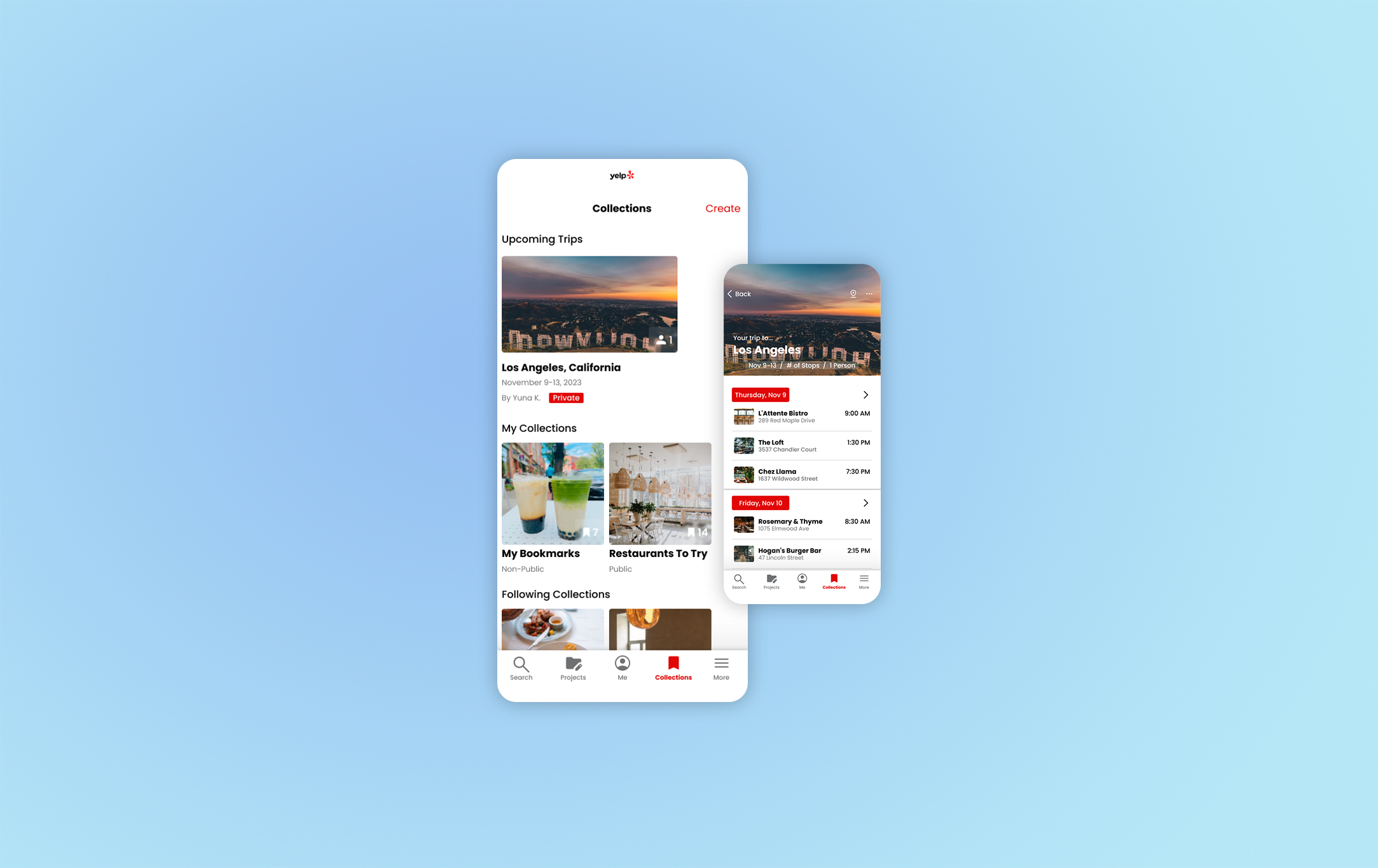
Yelp: Trip Itinerary Feature
My colleagues and I discovered an area of optimization in user experience for Yelp. Since Yelp lacks a way for users to create and organize trips based on food, there is an opportunity to improve the user experience by modifying Yelp’s current tool set to offer an in-app solution for this issue.
We also considered how we might leverage genAI to enhance the user experience with this proposed feature.
MY ROLE
UX Designer
TEAM
1 UX Designer
1 UX Researcher
2 UI Designers
PROJECT TYPE
App, Design Exploration
YEAR
2023
Initial Research
To better understand if there was real interest in this type of feature, we conducted initial user interviews with the goals of:
Understand user habits around travel itinerary creation (platform, approach, solo vs communal planning)
Identify the extent to which food impacts the travel planning process
PARTICIPANTS: 8 adults ranging from 28-50 years of age
USER SEGMENTATION: current yelp users & foodies
Findings
Users care about reliable recommendations, accurate restaurant information, and unique experiences.
FINDING #1: “I like getting recommendations from my friends or people I know in my community.”
FINDING #2: “When I look for food options, the price and proximity are most important.”
FINDING #3: “I want to have experiences that are unique to the area I am visiting.”
UX Benchmarking
By comparing Yelp’s primary features against their biggest competitors in the industry, we found that there was an opportunity for Yelp to gain an advantage by building out a feature that allows users to plan trips in the Yelp app.

Additional Insights: Travel Planning
Discovery research revealed that a few of Yelp’s competitors were experimenting with travel planning tools.
-
As of late 2023, they’re beta testing an AI tool that helps users “plan a trip” by answering a few simple questions.
-
While they have a trip planning feature, it is not holistic and does not allow users to plan a day-by-day itinerary.
Visualizing a User-Centered Experience


In our initial lo-fi prototype, we prioritized figuring out where this new trip itinerary feature would live within the Yelp mobile application.
User Needs & Needs Met
-
THE FIX: We adjusted the location and size of the ‘Add Stop’ CTA so that it was more visible and easier to locate.
-
THE FIX: To reduce confusion, we removed the accordion and simplified how daily itinerary information was displayed.
Target Users
To prioritize the user in our design process, my team and I created two personas that represented two kinds of potential Yelp travel users: a solo traveler and a group traveler.
Meet Yuna — a food and lifestyle infulencer who uses Yelp to discover new restaurants and places to visit.

-
Completes extensive research on each place she visits, reading lots of reviews, watching other influencer’s content, and clicking through images.
Tries to find the most “instagrammable” places to visit.
Doesn’t like to rent cars so likes having destinations to walk to or take easy transportation to.
-
Aesthetically pleasing location and food presentation to develop content.
Relevant reviews and ratings from people in her network.
Recent pictures of restaurants she’s interested in visiting.
Be more immersed a city’s unique culture and history through food.
-
Frustrated by the lack of information around location safety for solo travelers
Meals for dietary restrictions are not highlighted on restaurant’s page
Lack of transparency with wait times
Meet Eddie — the oldest child from a family of six who uses Yelp to discover new places his family will enjoy visiting.

-
Tech savvy
Uses Yelp and other social media sites (tiktok, instagram) to get trip ideas and food recs from his friends & influencers he follows
Very organized & responsible
Takes everyone’s opinions into account while planning
Chooses the activities first, and then sees what food options are nearby
-
Cost effective dining options for large families.
Activities for multiple generations - parents, teens, kids.
Proper price estimates on attractions to plan something within his parent’s budget.
-
Confusion around price points
Budgeting for large familyHidden costs / fees that mess with the budget
Restaurant doesn’t have the space/table size to comfortably accommodate the whole family
Usability Test Findings
Our user needs a way to create flexible, personalized trip itineraries centered around food using reviews and recommendations so that they can maximize their travel days with a combination of pre-planned activities and unique, spontaneous experiences.
High-level takeaways that informed our designs:
Give users the ability to curate a trip itinerary based on food to encourage immersion with local cultures and cuisines.
Offer users food recommendations based on their interests and geographic proximity that compliment their existing itinerary.
Create the ability for users to quickly adjust their daily plans based on individual needs.
Product Strategy and Recommendations
My colleagues and I established design aspects we wanted to include in our MVP (minimum viable product) for this design exercise.
-
Ability to adjust daily schedule/itinerary after initial trip creation
Ability to view daily trip itinerary at a glance
Seamless integration with the Yelp App’s existing branding and UI
-
Onboarding sequence to explain the new tool to users
Responsive design for the tool that is reflected on the Yelp desktop site.
Iterating from Low to High Fidelity


Future Product Roadmap: Key Points and Inquiries
Create a responsive design for Yelp’s desktop site
Finalizing the onboarding flow for mobile users.
Conduct user testing and analyze feedback